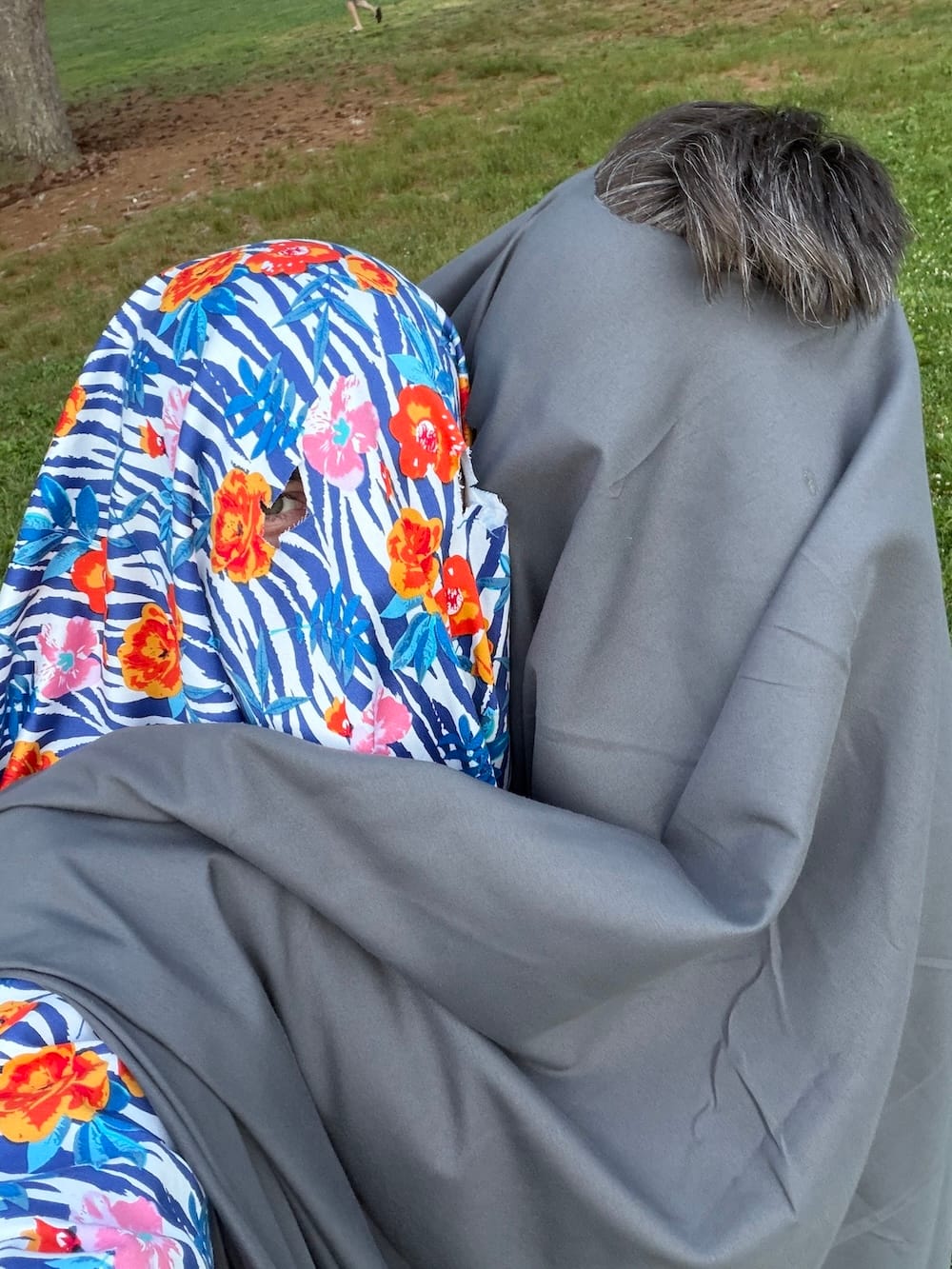
Vibecamp V
I am reviving this blog after 10 years. I rambled a lot in this post, and for that I apologize. These are vignettes of ideas and thoughts about my second Vibecamp.
"I have only made this letter longer because I have not had the time to make it shorter."
I already have some traditions, despite it only being my second time at Vibecamp. I “always” ride down with @metacontrarian and @mauve_sky. We “always” make the same stops along the way. @metacontrarian and I “always” take the same photo of us two in front of the barn. These rituals do an amazing job of preparing me for the weekend. I feel my excitement growing and body relaxing into something familiar. Like riding a bicycle, I have the few wobbly moments before I arrive and at the beginning and then I remember, oh yes, this is how it is.
On the ride down, @metacontrarian emphasized how nascent Vibecamp still is, and how it still doesn’t feel like it has any established rituals or traditions. Usually for the long-term viability of a yearly event, there has to be something you're looking forward to seeing again. Most of the time it’s the people. But people leave, and new people come, and in between, the people you already knew change and become different. Through it all, a tradition is a reminder of what core thing stays the same.
I consider @inflammateomnia a force of nature. JP is the founder of NYC office hours. He had been doing it for more than a year before I joined. From what I heard when he first started it, it was many weeks that only two or three people would show up, or he was just there by himself. The first office hours I went to had only three people: @metacontrarian, @superchthonic, and @ItamarLevyOr. They are the three I still feel are my closest friends from Office Hours (at that first OH, JP himself wasn't even there).
I told this story before, but it was JP's Dune II review he posted on Twitter that made me curious to go to Office Hours. It's funny how reading someone speak with intelligence, with a little nuance, or who just has something interesting to say, how far that can go. His post was about how movie Dune puts the power and consequence of action into the hands of human intention, not in inevitable Nature. The danger, at the root, comes from charismatic leaders. Maybe ironically, JP is a charismatic guy, and a good leader, and he convinced me to join something I otherwise might not have. I was curious about finding people who think a little more about what they're consuming, who notice the waters they're swimming in. I think I met him at my 4th or 5th office hours eventually. About a year later, he left NYC and a few of us inherited office hours from him, and I started taking over more of the responsibilities of organizing it.
I brought my husband to Vibecamp this year. It felt special to bring him, because over the two years I've been going to New York Office Hours, I've grown close to and enamored with the people there. To me, Vibecamp is the larger community from all over the world of people cut from that same "Office Hours" cloth.
It took a while to convince my husband to come. I have this bad habit: whenever I'm enamored with something, keen and into it, I describe it in a disparaging way. So when my husband would get angry at me for being on my phone: you spend so much time on your phone. I'd say, well, there's all these weirdos on the Nazi site I have to keep in contact with.
It doesn't create a good impression of what I'm spending my time on. It was legitimate of him to be worried, even angry, about what I was doing with my time. And once I started going to more in-person events, there was this added layer of: what is he doing with these people? What do you all do every Tuesday? And it's just talking and thinking and drinking and things like that. But the scene was the first place that gave me the confidence to think I had something to say to people, and that they would be keen to listen.
Only after a few weeks of going to NY Office Hours, I did a physics lecture series on quantum field theory for a bunch of people from there. They came over to my apartment and sat and listened and discussed for three hours every other week. Which is a lot, honestly, for such a tedious topic. But the people who came were actually interested in it. They wanted to know more. That surprised me. People whose background wasn't in physics, who didn't have that specific condition of well, I majored in this, so I really want to do it... they were naturally curious about it.
The first "Office Hours people" my husband met were these ones who came every other week to our apartment to learn about physics. He saw how much I lit up watching everyone talk about and discuss the things I was deeply interested in.
Something he's always said about what makes our marriage long-lasting is that we're always talking about ideas. We're always discussing the things we've seen and read in the world. We have book clubs just between the two of us. We haven’t really seen the movies, plays, TV shows, or read the articles or books, until we’ve had an in-depth discussion about them. The world is always full of new things, and old things too, PLENTY of old things too, and there's always something to discuss. The knowledge and discovery that's possible is infinite when it comes down to it.
So he saw something in these people who were coming to our apartment every other week. He saw how much time I was spending on it, preparing, studying, getting excited about it, and also how I still talked about the people in those undermining, disparaging tones. It caused a lot of tension: on one hand I was spending so much time on this, obviously caring about it; on the other hand I'd describe the people and my time as, oh, you know, just wasting a lot of time on Twitter. We argued about it. We went to therapy. I got better at (and am still working on) describing the things I cared about and not putting them down.
Eventually, I was able to convince Sebastian to come with me to Vibecamp. I had a lot of hopes for it. I will be honest, I wanted my husband to become part of the scene. I wanted him to talk with people and get that same spark I did when I found JP's Twitter long ago and felt like, oh, there's a group of people in New York City I can have these kinds of conversations with. I thought Vibecamp could be the place where Sebastian could find a lot of those people too. So I was anxious. I wondered: all the disparaging words I had said, would those be the things he'd pick out first? Would he be bored? Would he hate it? Or would he fall in love with the whole community the way I had?
I hosted an event at Vibecamp this year, which Sebastian helped me with. It was called VIBErant Colors, and the impetus for it matched what I think Vibecamp is about: what can a bunch of online people, once you get them offline, create that's unique because of the fact that they are actually in “the real world”?
The event was based on colors you can only see in person. Normal LED screens all follow the sRGB standard, which sits on top of the CIE color space defined back in the early twentieth century. While we have a lot of cool new LEDs and could probably fit more colors on a screen, you need to follow a standard to keep things consistent. So, we end up with this limited color space on our screens. Conformity! Not all the colors we can actually see with our eyes can be represented. And beyond that, there are things like fluorescence and iridescence that are hard to capture in a static image. Things shimmer; they change depending on how you move your eyes, how the light hits them. Even if you could represent the color, it's not easy to represent how it actually looks.
So I gathered iridescent beetles, an abalone shell, butterflies, sunset moths, acrylic paints of a vivid blue, peacock feathers. Sebastian laid them all out on a table in the meeting room at Vibecamp.
I also set up a spectroscopy lab. When you have a single gas in a tube (hydrogen, helium, argon, neon) and you run a high-voltage current through it, you excite the electrons in the atoms of that gas. The electrons get kicked up to higher orbitals by the energy from the current, and when they fall back down, they emit a photon. And because this is quantum mechanics, those orbitals sit at specific energy levels. You can't emit just any frequency of light: when an electron drops to a lower orbital, the photon it emits has one particular wavelength.
It's easiest to see this in hydrogen, because there's only one electron around its nucleus. The visible lines come from the Balmer series, the transitions that cascade back down to the second energy level (n=2), and you get three distinct photons: a violet one, a red one, and a vivid cyan one. The cyan is so vivid that it's one of those colors that can't be represented easily on a screen. You only get to see it in person.
So we darkened the whole meeting room, set up the spectroscopy lab, and handed out party glasses. The glasses are diffraction gratings: they split light into its constituent wavelengths. If you looked at sunlight, you would see the whole rainbow spread out, just like white light through a prism. But when you look at excited hydrogen gas, you don't get the full spectrum, because the electron can only emit photons at specific wavelengths as it falls back down. So instead of the full ROYGBIV of white light, you get just those three distinct colors: red, violet, and that vivid cyan.
While I explained all this and showed it to a group in the meeting room, Sebastian was in the other room demonstrating the animal parts, shells, paints, and beetles that show the same thing: colors you can't normally see with your eyes. It was a popular event; it got about 130 stars on the event website. People appreciated seeing, with their own eyes, a clear proof of quantum mechanics and an explanation of atomic orbitals. They thanked me for a clear explanation, and I was happy to continue my foray into being a physics teacher. Secretly (not so secretly?), that's something I've always wanted to be. So I'm grateful to Vibecamp for letting me play that.
Besides hydrogen, there were a lot of other gases: noble gases like krypton, argon, xenon. Their spectra were much more filled in, but there were still visible gaps, and people enjoyed seeing the vivid colors of these spectral lines. We did that for a full hour and a half, the two of us, and it was beautiful that I got to put on something like that with my husband.
Afterward, people came up with ideas about other things. @arcati81 collects rocks and minerals that fluoresce under UV. My husband met @abstract_thot in line for another event, and they described a paint with magnetic properties that behaves differently depending on the polarization or direction of light. So already the spirit of collaboration, of growth, of making something cool for next time and making it bigger, shone through. I see that as an amazing part of Vibecamp. That ability to take an idea, get inspired, collaborate, grow, and make it more amazing. It fills me with a lot of energy. It fills me with a lot of life.
Sebastian also hosted an event this year. It was his first year at Vibecamp and he already wanted to contribute. He created an event called Clown Games. He worried about it a little bit. Will people actually get it? Will they be enthusiastic about it? I was the TA for his event, the way he was for mine. There was a perfect number of people for the kind of games we were playing. He did an amazing job explaining the rules, and I think he was surprised how willing people were to do silly things and behave in a silly way. Having people so willing to go into something without fear, the fear of looking silly, because they know the others have their back, that they're in it with them, is an amazing thing. I was proud of Sebastian for jumping in head first, already feeling the spirit of the whole weekend. I think he understood what Vibecamp could be about.
All the while, I could still tell he was a bit distant from it. I could tell there was something holding him back.
My husband has a lot of issues with social media. He doesn't like the kind of life it creates in people, the time-wasting behaviors it creates. He dislikes that I use it. He told me he had a big fear at Vibecamp that he'd be tempted to start a Twitter account, something he didn't want to do, because even if it was for a "good reason", it wouldn't have good long-term consequences. Eventually the algorithm takes over: rage bait takes over the feed, and the time-wasting properties start to consume your life. He'd worked hard to break a lot of internet addictions in college and grad school, and there was no sense to him in just trying it again. "You can start drinking again, but just with friends, right? Just don't do it by yourself." It's hard not to fall back into old habits after you've successfully kicked them.
So I understood that. There were a lot of things I'd hoped he'd do instead: come to more in-person events in NYC, get a Substack. But I could tell my desires for him to join the scene weren't exactly what he wanted. And if he didn't want to be a part of the scene, doesn't that create a bit of a zero-sum game? In free moments, where did I spend my time? On private moments with him, or on hanging out with Office Hours people, organizing things, writing and scrolling on twitter, planning for lectures? Even around campfires singing, even in the tree net in each other's arms, even on a relaxing morning in the tent under the shade of the trees, even saying he got a lot out of events, would I always be in this world apart? I'm the guy who's in the scene. I'm the TPOT guy. Wouldn't it be easier if he was in it too? But he didn't want that for himself.
It presents a big question: when the person you love is into something you yourself aren't into, what do you do with this gap in your relationship? I said to him, "If you're in love with me, I think you'd fall in love with them, too!" But what if it just doesn't match up that way?
We did an interview together for the Vibecamp documentary. Vibecamp itself is at an interesting point: not everybody coming to Vibecamp now is from Twitter, or even has a Twitter account. Whether it's my husband, or other people who've been brought by friends and significant others, the people who come to Vibecamp now are beyond the people who built and came to the first one. You can then ask: what does Vibecamp look like now? When even the common origin isn't shared anymore, what does it become?
This year, JP got it in his mind to build a tabernacle at Vibecamp. That was something I wanted to help with, out of respect for JP and as a way of giving back to what he had made. As a way of saying thank you for the community he introduced me to. And what a fine tabernacle it was, for being so simple: six benches, string lights hung in the middle of a forest, and rope wrapped around trees to vault up the idea of a ceiling. Initially there wasn't even enough rope to make the ceiling, until JP brought some ingenuity, some shortening and cutting down of things, some song to go along with the work. JP is resourceful, even with few materials. He can make something amazing happen from shoestring and gum and a few paper clips. MacGyvering a cultural scene out of very little. I think it's a powerful thing he's able to do.
I will say, I wasn’t ready for JP’s midnight mass event to truly be a midnight mass.
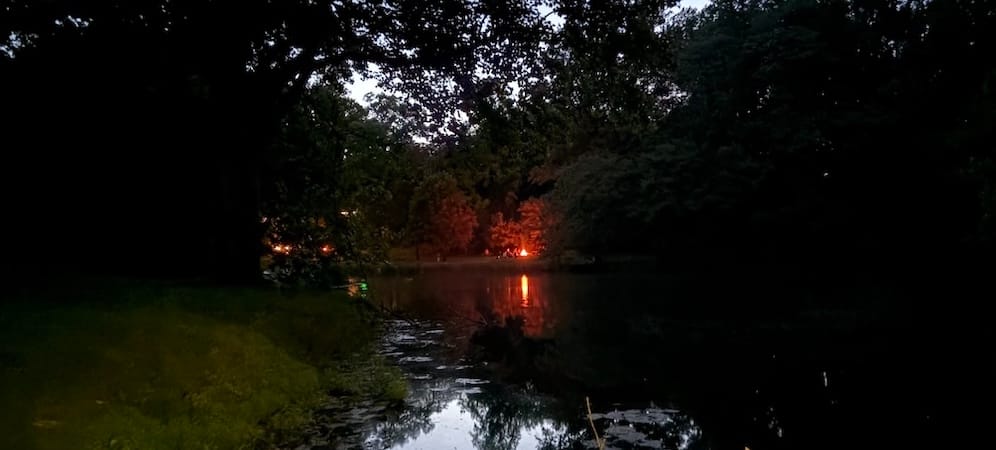
Walking through the forested path in the dark and coming across a fairy-light-covered frame
the outline of a chapel
seeing the wooden pews that JP and others had built over two days in the hot sun
being surprised at how many people were there, that there wasn't even room in the pews
It was like a Christmas Mass, where everyone who usually doesn't go to church has decided to come for their one obligated night of communion. The church itself, usually full of free pews, suddenly has no room to sit, and has people crowding in the back and along the sides.
Sebastian and I stood together in the back, listening to the first speech by @jazz_bard, about deep deep time time, about the felt sense of the land we stand on, so old that the river Susquehanna used to flow backwards, and how one day in the future it'll flow backwards once again. The resonance of people in a tradition, in community, with shared values, from different origins, all coming together for some common goal. But I thought: what is that common goal? What is the common thing everybody there shared?
After the speech, JP talked about trying to live up to an ideal, failing, and trying again, about Mea Cupla, and led everyone in a rendition of the Lord's Prayer. This all immediately triggered something in me and my husband. He grew up Catholic, as I did too, but I grew up in the very Italian, not-very-serious way. We went to Church when we felt like it (not often). But my husband had been very serious in the church. He went to Wednesday services, he did the adoration of the Eucharist, participating in the twenty-four hours of constant prayer in front of the Blessed Sacrament. And there was a moment in his life and mine, I think this is a moment in a lot of gay men's lives, where the fundamental incompatibility between how the church asks you to live in order to take communion and the kind of life you want to live breaks something inside you, and you leave your former community. In a way, it's thanks to the church that you can have such a resolute, strong acceptance of what you truly feel and what you think is the right way to live.
A lot of gay Catholics end up Episcopalian, but the breaking can be strong enough that you become skeptical of all religious systems for the rest of your life. JP was tapping into something raw at midnight Mass, an ideal sense of what a church service should be, what it should represent to a community, free of hypocrisy. Using so much of what a real midnight mass would sound like was enough to make us have to leave. And along the way back, as we heard Amazing Grace fading behind us, I had a beautiful discussion with my husband about what religion means in a community that traces its roots back to rationalism and skepticism. It was emotionally powerful, yes, but we can't be gullible about such things.
But it makes sense. I feel there is a common thing a lot of people at Vibecamp share: that general yearning for a future of people in communion, in community, building something for the benefit of everybody else. It's a fundamentally optimistic place to be. It's also an intoxicating place to be in, especially when so much of the world now, and so much of what you hear about the future, is so pessimistic. Vibecamp feels like it has no ideology apart from an ideology of optimism. And yet, what egregores lie in the shadows of that, waiting to replace that vague feeling with its own conception?
So far, the community at large has resisted being fully co-opted by one ideology. And I think that's in large part due to the skeptical, rationalist, scientific, and educated underpinnings of a lot of people. I don’t think people will en masse convert to Catholicism from one moving midnight Mass. But maybe some considered it more afterward, and maybe their hearts opened in a way they hadn't in a long time.
I know my husband and I found that the church doesn't fulfill that for us in our lives anymore. Of course the influence of the church will always be part of our origin stories, the core of how we grew up, but breaking away from that tradition is also a large part of our story. And I'm grateful for that touch of the old religion in that evening, for generating the moving moment between me and my husband as we talked on the porch of the cabin about the things that are important to us, about what community and building an optimistic future look like, and what kind of ideas or ideology support that.
It was beautiful to see the congregation, with all their flashlights, walk out of the forest like the fireflies that were out that night, and slowly move down to the pavilion for @embryosophy's set, where everybody then danced in the night. So while I didn't stay for the entire midnight Mass, it's still one of my favorite moments. I'm glad I got to help build the tabernacle. I'm glad I got that moment of closeness with my husband. I'm glad that all of us, no matter how we felt, danced in the pavilion together afterwards.
I don't know whether my husband will come to Vibecamp next year. And we'll keep on talking about how he feels about my continued involvement in the New York Office Hours scene, and the scene at large, and my use of Twitter. I think he now sees where my interest in it comes from, at least. That it's not a negative pull on my life but a positive one. I don't think he worries as much about me anymore (I hope). But maybe what worries him is where that puts him in my life. Where does the scene have space for him? And is it a scene he even wants to be part of?
We all change over the course of our lives. When you're together for fourteen years, you're going to end up with different interests than you had more than a decade ago, and maybe even wind up in different communities. It's an inevitable thing you have to navigate and talk through together. It's painful to know that we have become different than what we were before. We want things to last and not become unrecognizable. Sebastian and I got a self-uniting marriage five years ago. Our oaths didn't come with a promise to God but a personal promise fully between each other. Our only witnesses were own own hearts and that of our immediate family. Vibecamp itself has now been 5 years going too, and has changed a lot, from what I've heard and read from others. It's a bit unrecognizable in some ways from what it was at Vibecamp 1. But is there not a soul, a permanent thing that persists even as its form transmutes?
In a marriage, you make an agreement to stick with each other despite all the ups and downs, because of that idea, that promise of some immutable, permanent thing between you. Marriages are between two people, but there are similar covenants between friends, communities, and individuals with their God. Like literally everything, the surface of the thing is going to change. To find the constant, immutable thing again, it is a process that requires curiosity and discovery and rediscovery. We despair in the loss, but then delight in seeing the new thing it's turned into, the symmetry it still has, the transmutation into something fresh.